Contemplation on Collision Prevention
What is Headway
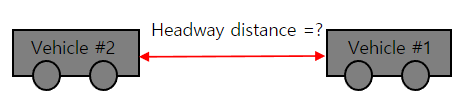
Headway is the distance or time between vehicles in transit system. The minimum headway is the shortest distance or time achievable by a system without a reduction in the speed of vehicles. The precise definition varies depending on the application, but it is most commonly measured as the distance from the tip (front end) of one vehicle to the tip of the next one behind it.
https://en.wikipedia.org/wiki/Headway
Headway - Wikipedia
From Wikipedia, the free encyclopedia Distance between vehicles in a transit system measured in time or space Headway is the distance or duration between vehicles in a transit system measured in space or time. The minimum headway is the shortest such dista
en.wikipedia.org
Vehicles examples
Standard vehicle control and operation make sure that vehicles always have a safe stopping distance(headway).
1. headway distance
\[v_f^2=v_i^2+2as\] where :
-. \(v_f^2\) is the final speed of the vehicles
-. \(v_i^2\) is the initial speed of the vehicles
-. \(a\) is the acceleration
-. \(s\) is the minimum headway distance
since the velocity is zero at rest \[0=v_i^2+2(-a)s\] \[v_i^2=2as\] \[s=\frac{v_i^2}{2a}\]
2. headway time
\[T_{{min}}=t_{r}+{\frac {kV}{2}}\left({\frac {1}{a_{f}}}-{\frac {1}{a_{l}}}\right) \] where:
-. \(T_{{min}}\) is the minimum safe headway time
-. \(V\) is the speed of the vehicles
-. \(t_{r}\) is the reaction time, the maximum time it takes for a following vehicle to detect a malfunction in the leader, and to fully apply the emergency brakes.
-. \({a_{f}}\) is the minimum braking deceleration of the follower.
-. \({a_{l}}\) is the maximum braking deceleration of the leader. For brick-wall considerations, \({a_{l}}\) is infinite and this consideration is eliminated.
-. \(k\) is an arbitrary safety factor, greater than or equal to 1.
The tip-to-tip headway is simply the tip-to-tail headway plus the length of the vehicle, expressed in time:
\[T_{{tot}}={\frac {L}{V}}+t_{r}+{\frac {kV}{2}}\left({\frac {1}{a_{f}}}-{\frac {1}{a_{l}}}\right)\] where :
-. \(T_{{tot}}\) time for vehicle and headway to pass a point
-. \(L\) is the vehicle length
Thrust Limitations

-. When a vehicle is commanded with a higher acceleration than its maximum acceleration, The vehicle falls behind its ideal move profile while accelerating. Figure shows the ideal move profile(solid line) and the degraded move profile(dashed line).
-. In addition, and more critically, the vehicle is not able to decelerate at the specified rate and overshoots its destination as shown by the dashed line. This behavior can result in vehicles colliding with other vehicles. or loss of control of a vehicle as it exits the area where it has permission to move. Thus, it is important to avoid commanding a move with an acceleration that is higher than the deceleration capability of the system.